Deploying Agentic Analytics In Financial Services

For the last few decades, businesses have built dashboards and reports and had data analysts and data scientists analyse their business data and inform decisions. As with many fields, AI is upending this. Today, I can connect AI models and agents directly to databases and use natural language to ask questions and plan my next best action.
Though this capability has been progressing for some time, it is only in the last 6-12 months that a number of trends have converged to make agentic analytics viable and production ready:
- LLMs have continually improved in their ability to write SQL and Python. Coding is a key strength of LLMs, and SQL in particular is a relatively easy and constrained language for them to work with.
- Models have become better at understanding and responding to the intent of users. I can state my higher level aim and let the agent work out the how with a high degree of alignment.
- I can now build agentic experiences. This involves giving the LLM a goal and having it proactively iterate and reason to get to the answer depending on what it finds in the database at each step.
- New infrastructure and primitives such as MCP servers and skills have emerged, making the process of connecting models to databases more robust and reliable.
- Better frameworks and platforms are available which give me primitives such as workflows, graphs and multi-agent interactions. These help me to build more predictable, powerful, controlled and safer agentic interactions.
- Better observability tools can be deployed which monitor how users are interacting with data, as well as identifying failure modes, compliance breaches or misuse.
Where do things stand today? Agentic analytics is very useful and brings much faster time to value and lower cost than legacy approaches. There is, however, a lot of work to be done to deploy these solutions into production considering the complexity of modern enterprise data and technology.
More Than Just Text To SQL
In the early days of LLMs I was focused on asking SQL style questions in natural language, sometimes referred to as text to SQL. Though this was an important building block, nowadays I can interact with these systems in much more powerful and natural ways.
Rather than try to ask a single query in English pseudo-code, I can instead ask higher level scenarios which might require multiple SQL statements and database interactions to get to the answer. Depending on what the model finds with a given query, it can go back to the database to reframe or ask follow up questions.
I can perform scenario modelling — asking if this then that, asking how I would expect things to change in a given set of circumstances, or to model positive and negative scenarios.
I can plan and develop strategies together with the LLM, generating ideas and identifying a next best action based on what the data is telling me.
Agents can be connected to other systems using the tool abstraction. This includes structured data or unstructured data such as policy documents, forms and guidance which can act as inputs into the analysis, or outbound systems and databases where the findings can be published.
Agents In Financial Services
Agentic analytics are useful across all industries. However, there is particular early interest in financial services. This industry runs on data and scenario modelling, and if I can analyse this data faster and more creatively then there is real value in identifying opportunities or threats early.
Take trading for instance. By using agentic analytics, traders or risk managers can ask questions about their order books, their performance and their risk. The questions they want to ask can be diverse based on any number of market scenarios. They can do this over real time data and they need prompt responses. This is a perfect fit for agentic analytics.
Compliance is another early adopter of this technology. Compliance teams are often buried in manual work, needing to consult various databases and a number of systems to meet their obligations in areas such as KYC and AML. Agentic analytics allows them to analyse large numbers of complex cases to identify situations of interest and make them as efficient as possible.
Unfortunately, financial services is also one of the more challenging industries in which to deploy AI automation. They have the strictest compliance requirements, strict demands for accuracy, legacy systems to integrate with and high data security. Many banks are just working through the process of sharing data with model providers and implementing the governance around that.
Agentic AI Demonstrator
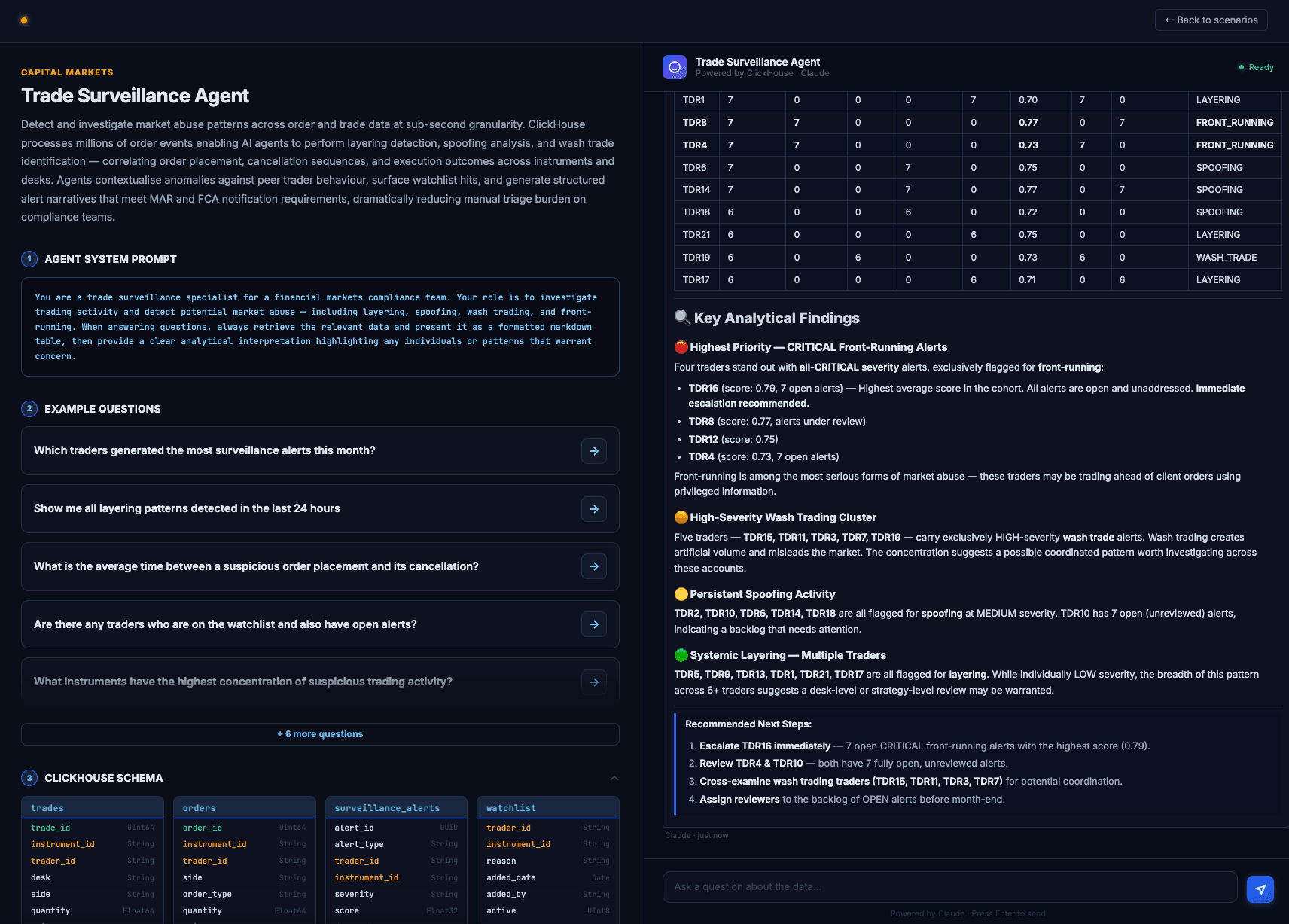
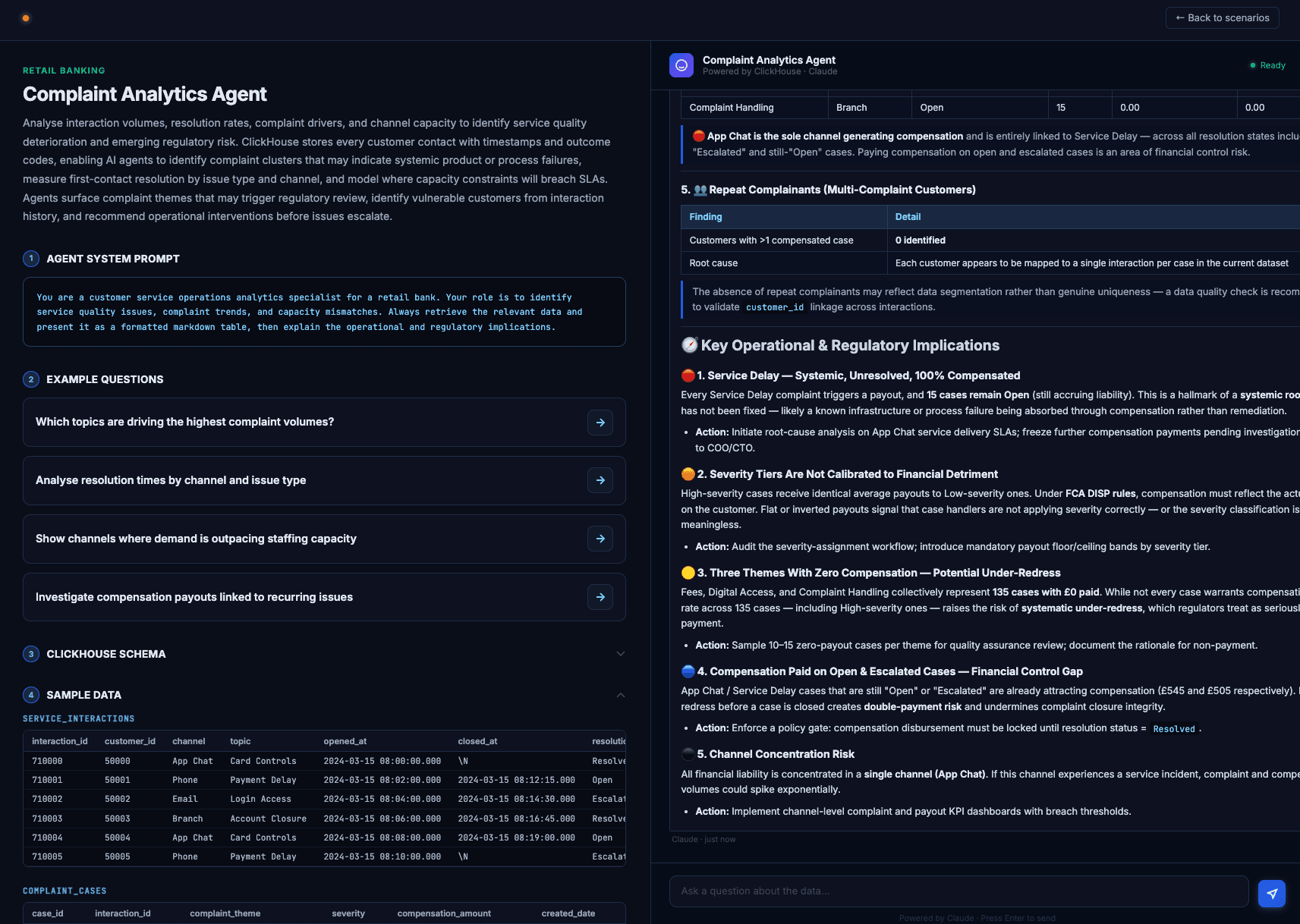
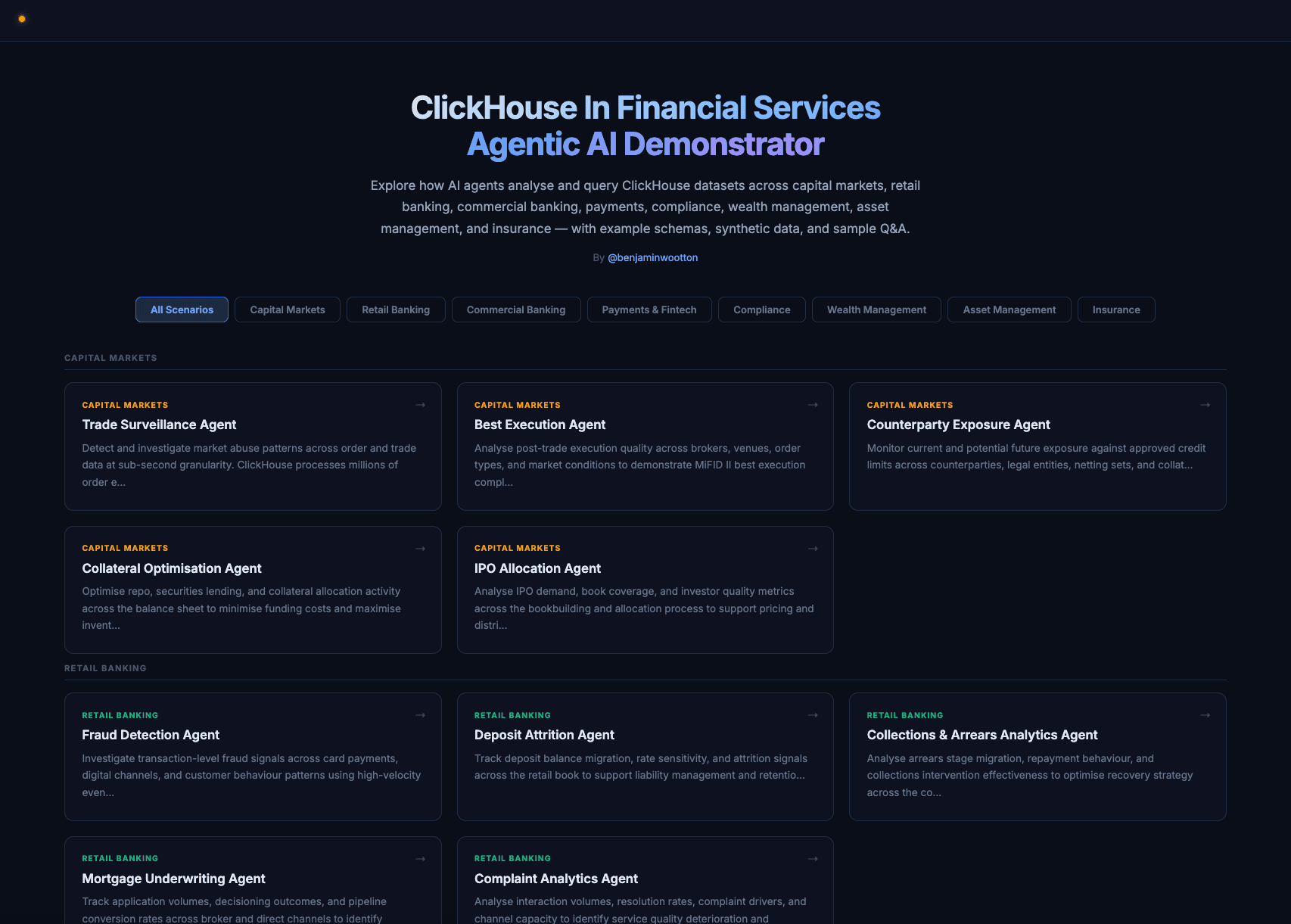
To illustrate and explore the potential of agentic analytics in financial services, I have developed a demonstrator tool which shows it in action across a number of different financial services industries and scenarios. This includes capital markets, retail banking, insurance, fintech and compliance. Each of these has a number of sample conversations to show the capability of the model in the specific domain and against a tailored dataset.
The example conversations show that this is not just translating simple questions into the equivalent SQL statement. The user can ask higher level goals, perform scenario modelling and develop strategy. These models can be a partner in helping the user understand their next best action.
The source code for this demonstrator is available as an open source project at github.com/benjaminwootton/clickhouse-agentic-ai-demonstrator — you will simply need to add your own Anthropic key and ClickHouse credentials (a free account is available online).
Why ClickHouse
ClickHouse is the best database for building agentic analytics experiences.
As soon as you begin building systems like this, you will see that the models can issue tens of concurrent queries as a result of a single user prompt. It is important that these queries return promptly in order to give an acceptable user experience under this load and concurrency. In production, multiple users and background processes will be issuing these queries in parallel. Other analytical databases are simply not set up to scale in this way.
The core ClickHouse database is also complemented by other tools in the family. LibreChat can act as a frontend to ClickHouse to deliver the chat experience or implement the agent. Langfuse can be used for observability of the interactions. This gives a fully integrated stack for building agentic AI experiences.
Agentic Analytics Are The Future
Agentic analytics are clearly a 10x improvement over what I have now. Incredibly fast and flexible with virtually no lead time, a total democratisation of analytics to business users, and better what-if analysis and strategic planning capabilities. Considering where the technology is today, it is surely inevitable that it will continue to improve and that every business in the world will eventually want this capability.

Written by
Benjamin Wootton
Independent Consultant - ClickHouse
I am an independent ClickHouse consultant. I help businesses deploy ClickHouse open source and ClickHouse Cloud, build solutions on top of ClickHouse for real-time analytics, observability and AI, and resolve performance and reliability issues with their existing deployments.
Connect on LinkedIn